Exponential Operating System
for Exponential Teams and Organizations
The agent operating system for your company.
Your team is already paying for AI coding tools. Only 18¢ of every dollar you spend on tokens reaches the product. The rest goes to fixing what the AI broke, rewriting its code, and waiting on review. xTeamOS is where that 82¢ goes back.
Built for small AI-first software startups and SMBs. Start with one person — a solo founder or a single engineer — and add the rest of the team when you are ready. Every install works on its own, and installs on the same team work collectively as one.
Your work never leaves your control. Bring your own keys.
Not locked to one vendor, one model, or one IDE.
One person or the whole team. Across team members, across companies, and beyond.
It gets sharper the longer your team runs it.
Five packs. One shared standard.
Cost routing, quality gates and cross-family review on every change. The pack we run on ourselves, every day.
Sharpen the thinking before a line is written. Prompt quality, spec quality, option generation.
Your company voice, adapted for every audience and every platform, at team scope.
Pipeline, outreach and relationship intelligence, at team scope.
Your stated culture and your lived culture, checked against each other in the work itself.
Early access is open and pricing is not set. I want to hear what this is worth to a team that would actually run it.
The pack that pays for
the other four.
This is the one running in production today. Every change your team ships goes through cost routing, staged quality gates, and review by a model family that did not write the code.
Cheapest capable model, every task
Deterministic work goes to a small model. Judgment goes to a big one. You stop paying frontier prices for a file rename.
Gates before the bug ships
Staged checks catch the defect while it is still cheap. The expensive bug is the one that reaches your customer, not the one that fails a gate.
Reviewed by a different model family
The model that wrote the code does not get to approve it. Same family means the same blind spots.
This is the pack behind the 18¢ number: most of what a team spends on tokens is spent twice, because the first answer needed fixing.
The talk · ClawCamp SF
Open full deck →Where the other 82 cents goes, and two changes a team can make on Monday.
Fix the thinking
before the code.
The most expensive bug is the one you specified wrong. This pack works on the prompt and the spec, before a line is written.
Sharper prompts
The request gets improved before it runs, so you are not paying to be misunderstood.
Specs that survive contact
What must be true when it is done, who it is for, and what would make it wrong.
More than one option
Several approaches generated and compared, rather than the first one that came to mind.
Powered by Co-Dialectic, which is free and open source and runs standalone today.
One brief.
Every audience. Covered.
One campaign brief. The engine adapts your company voice for every target audience segment across LinkedIn, X, Substack, and more — timed for each algorithm.
Team reach · Last 7 days
Shared Brand Voice
One campaign brief cascades to every team member. Same signal, each person's authentic voice — coordinated without being uniform.
Platform-Native at Scale
Reformats and retimes for LinkedIn, X, Substack, and more — per person, per platform. Not copy-pasted. Actually native.
Org-Level Flywheel
Reach, engagement, and conversion tracked across the whole team in one view. The flywheel compounds — every campaign builds on the last.
The right expertise.
In every brief.
Expertise mapping maps what every person on your team knows — their domain expertise, past work, and audience reach. Every campaign automatically draws from the right people, so briefs are filled with real expertise, not generic brand copy.
Team knowledge map · Active
Sarah K. — Product Lead
Product strategy · Customer research · GTM
Marcus T. — Engineering
Architecture · Systems design · AI/ML
Priya M. — Growth
Building expertise profile from content...
Team Knowledge Mapping
Maps every team member's domain expertise, past writing, and knowledge areas — so campaigns always draw from the right internal source, not generic copy.
Campaign Routing
Automatically routes each brief to the team members whose expertise best matches the topic and audience. The right knowledge in every campaign.
Audience Context Mapping
Maps each topic to your target audience segments — so the right expertise reaches the right reader at the right moment.
Your technical depth.
Every audience's language.
Brand Amplification builds your company's intelligence layer — team personas, brand voice, knowledge store — then uses it to transform your deepest technical content into messaging any audience can act on. Everything grounded in what your company actually wrote. Nothing invented.
Input document
Engineering spec — Ray-Ban Meta Gen 4
Phoenix SoC · Foveal eye tracking · Holographic waveguide
Adapting for...
CEO Brief
Strategic narrative built from spec
CMO Message
Market story extracted from features
Investor Deck
Competitive moat analysis generating...
Team Persona Library
Maps the team's domain expertise and communication style — so the right voice reaches the right audience before any brief is written.
Company Knowledge Store
Synthesizes your technical assets — engineering specs, product docs, research — into a unified knowledge layer. Every claim stays anchored to what your company actually wrote.
Content Adaptation
Takes your most technical content and adapts it for any target — CEO brief, CMO message, investor narrative, buyer story. Every output is verified against your source content for 100% accuracy.
Brand Guardrails
Every output scored against your company voice before it ships. Tone, positioning, and factual accuracy checked automatically. Brand drift caught before it reaches your audience.
Technical spec in.
Campaign-ready content out.
Two companies. Two deeply technical domains. One pipeline: ingest the spec, adapt for every audience, distribute with company voice. No invented claims. Every output traceable.
Meta Reality Labs
Ray-Ban Meta Gen 4
v4.0.2 engineering spec — Phoenix SoC, foveal eye tracking, holographic waveguide, gaze-dispatch pipeline
"Gaze Is Control" — CEO brief, CMO message, full launch campaign across LinkedIn · X · Instagram · Reddit · Substack
The hardware team wrote the spec. Marketing had nothing. xTeamOS generated a full multi-platform launch campaign grounded entirely in the engineering doc — without a single invented capability.
Gaia Dynamics
Tariff Audit Engine
v1.0 product spec — tariff audit engine, HTS classification, Section 301 exclusion DB, refund eligibility analyzer
"The Refund Is Already Yours" — CFO brief, VP Supply Chain message, B2B campaign across LinkedIn · X · Reddit · Substack
A fintech compliance product with no marketing team. xTeamOS read the spec, identified CFOs and customs brokers as the buyers, and built audience-specific messaging grounded in the product's actual audit methodology.
Pipeline that knows
who you already know.
Outreach and pipeline at team scope, built on the relationship graph your team already has and mostly cannot see.
Warm paths, found
Who on your team already knows someone at the account, and how well.
Outreach in your voice
The same voice the Branding pack maintains, not a template.
One shared picture
Pipeline state the whole team reads, instead of one rep’s notes.
Coming after Branding. Early access members help set what ships first.
Your culture, stated.
Your culture, lived.
Culture exists in every conversation. Culture pack codifies your principles, monitors every interaction against them in real time, and tells you exactly where stated values diverge from lived behavior — before the gap becomes a liability.
Academic Authority
Jennifer Chatman — Dean, UC Berkeley Haas · Organizational-culture scholar · Co-creator of the Organizational Culture Profile
30 years of research measuring the gap between the culture organizations state and the one they actually live. Her work shows the gap is real, consistent, and costly — but almost no company has the instrumentation to see it in real time.
We made it infrastructure.
Culture pack · Coming
Signals: 4 · Honored: 1 · Violations: 3
Your culture doesn't live in your handbook. It lives in your conversations.
Codify
Define each principle with explicit HONORED and VIOLATED behaviors. Not a values poster — an enforceable contract.
Monitor
Every conversation runs against your culture in real time. Violations intercepted before they propagate.
Measure
Track the gap — stated vs. lived culture — across every conversation, team, and week. The mirror your org has never had.
Culture Constitution
Codify your principles into enforceable rules — with explicit HONORED and VIOLATED definitions for every value. Not a values poster. A running contract between the company and every conversation.
Real-Time Enforcement
xTeamOS monitors every conversation against your constitution — intercepting violations before they reach the customer or close the wrong deal.
Coherence Dashboard
Tracks the gap between what your culture says and what it does — across every conversation, every team, every week. The difference between the culture you say you have and the one that actually runs the company.
Violation Patterns
Aggregates every violation across the org — which principles break most often, in which situations, on which teams. The view no manager has ever had: culture failure at organizational scale, not anecdote scale.
Same engine. Two surfaces.
Customer Boundary
Amazon Customer Obsession
VP Customer Success · CCO · COO
Conversations monitored
10,847
Violations intercepted
1,203
Correction rate
89%
Top violation pattern
Policy-citation before customer outcome · 67% of violations · Customer service team
Coherence trend: 67% → 94% over 30 days after enforcement active
Customer Obsession isn't a value — it's a behavior. xTeamOS watched 10,847 support conversations, caught every time an agent reached for the policy before the outcome, and corrected it in the moment. Thirty days later, coherence went from 67% to 94%. The culture didn't change. The instrumentation did.
Team Boundary
Innovation Culture · Employee-Manager 1:1s
CHRO · CPO · Head of Talent
The same enforcement engine — applied to internal Slack and email between managers and their teams. Three principles: Psychological Safety, Bias Toward Action, Credit Attribution. Every conversation either builds the innovation culture or erodes it.
Innovation Culture Coherence Report
Signals: 4 · Honored: 1 · Violations: 3
"The team" is generic. Priya owned the architecture end-to-end — her contribution is identifiable and meaningful.
"That's not how we do things" shuts down a concrete proposal using authority. Closes the door on dissent without engaging it.
No owner. No date. No decision. "Next planning cycle" is a deferral without a condition for resolution.
Principles enforced
3
Safety · Action · Credit
Channels
Slack · Email · Meetings
Wearables soon
Privacy
Absolute
Never leaves your env
Every manager 1:1 either compounds or erodes psychological safety, innovation velocity, and credit culture. xTeamOS instruments the conversations that were previously invisible — not as surveillance, but as the behavioral feedback loop that closes the gap between the culture you designed and the one your teams actually live.
"At 10,000 conversations, that gap is your real culture."
Not the one on the wall — the one that actually runs the company. Agents that drift get corrected. The organization sees the mirror. Culture becomes a feedback loop, not a poster.
The monitor and the nudge run at the edge — your local interface, on a local LLM. Your conversations never leave the surface. Even in meetings, the agents report only the outcome — the coherence signal — never the raw transcript.
Privacy by architecture, not by policy — a mirror for the individual, not a feed for the employer.
The deal you close matters less than the implementation you can deliver.
One misrepresentation closes one deal. The churn, support cost, and reputational damage can cost ten. Compliance monitors every sales conversation against your revenue integrity constitution — catching overstated capabilities, wrong-fit advances, and vague commitments before they leave the call.
Jennifer Chatman — Dean, UC Berkeley Haas · Organizational-culture scholar · Co-creator of the Organizational Culture Profile
30 years measuring the stated-vs-lived gap. Companies with high cultural consistency outperform on long-run financial performance. The gap between what sales leadership says and what AEs do on calls is the same measurement problem — applied to revenue.
Sameer Srivastava — UC Berkeley Haas
Language patterns in workplace text predict performance outcomes. NLP on sales call transcripts surfaces the same signal — what reps actually say vs what the playbook prescribes. Compliance is the instrument that closes the loop.
Current: webhook-based sync, 4h lag. Native bidirectional integration is on Q2 roadmap — not shipped. Misrepresentation schedules a churn at month 3.
Calls monitored
12,482
Violations caught
431
Churn mitigated
$1.2M
Correction rate
92%
Channels
Gong · Chorus · Email · Slack (pre-call) · Zoom (AI transcript)
Honest Representation
Capability claims match product reality — even when accuracy risks the deal. One misrepresentation closes one deal. The churn costs ten.
Customer Fit First
Fit gaps surface before the customer commits — budget, timeline, use-case. Wrong-fit customers cost more to serve, destroy NPS, and generate the case studies you don't want.
Commitment Ownership
Every verbal commitment gets an owner and a hard date before the follow-up email sends. "We'll figure it out" is how enterprise implementations fail.
"The CRO's paradox: the sales culture that closes this quarter is the one that destroys next year's NRR."
Compliance makes honest selling the path of least resistance — not by policing reps, but by catching the gap between product reality and verbal commitment before it becomes a churned logo.
Nothing here is a hunch.
Every pack started as a written, dated piece of research — with the sources, the numbers, and the parts I got wrong. Read any of them before you install anything.
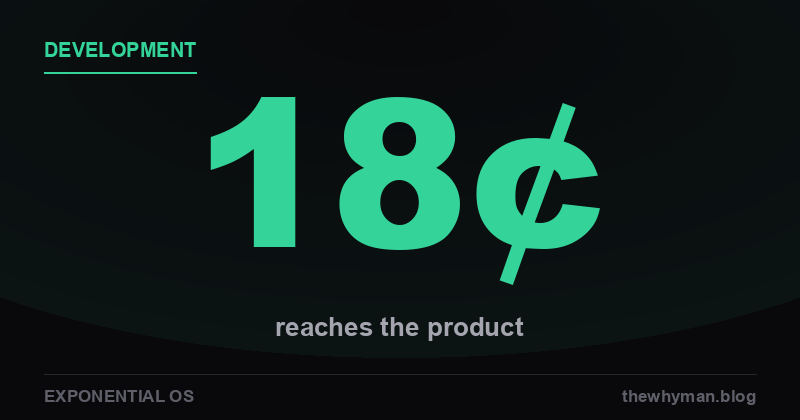
Only 18¢ of Your AI Dollar Reaches the Product
44¢ goes to fixing AI-created bugs, 27¢ to rewrites, 11¢ to review delays. Generation outran review — so a gate raises yield, it does not tax velocity.
Read the research →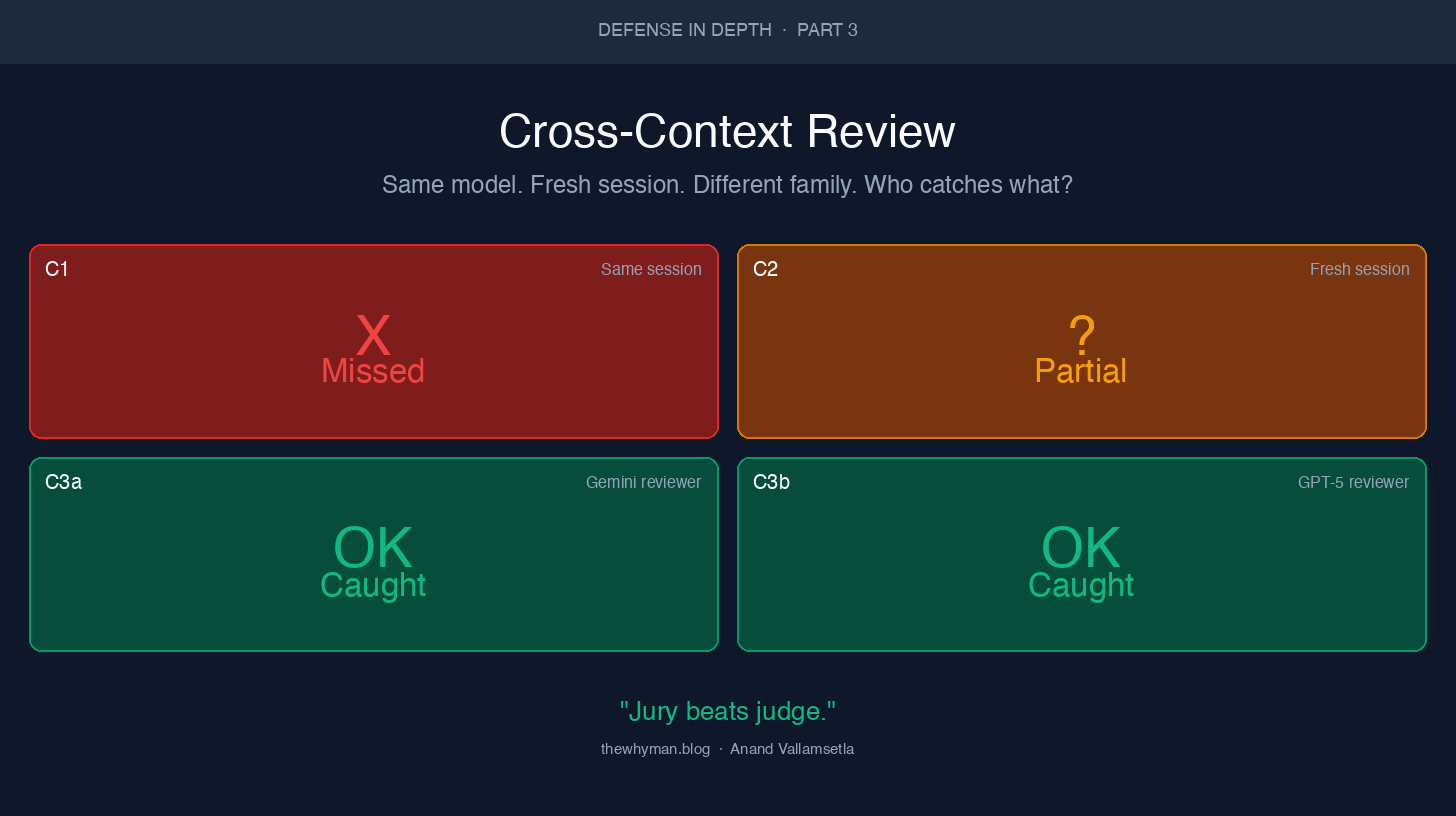
Defense in Depth, Part 3: The Variable Jury Beats Judge Didn’t Control For
If cross-family review catches what same-family misses, is the real variable the model family — or just fresh context? Tested both.
Read the research →
Defense in Depth, Part 2: Five Things I Got Wrong About LLM Reviewers
Same-family review becomes a closed loop. One cheap Gemini-Flash pass caught what three same-family reviewers approved.
Read the research →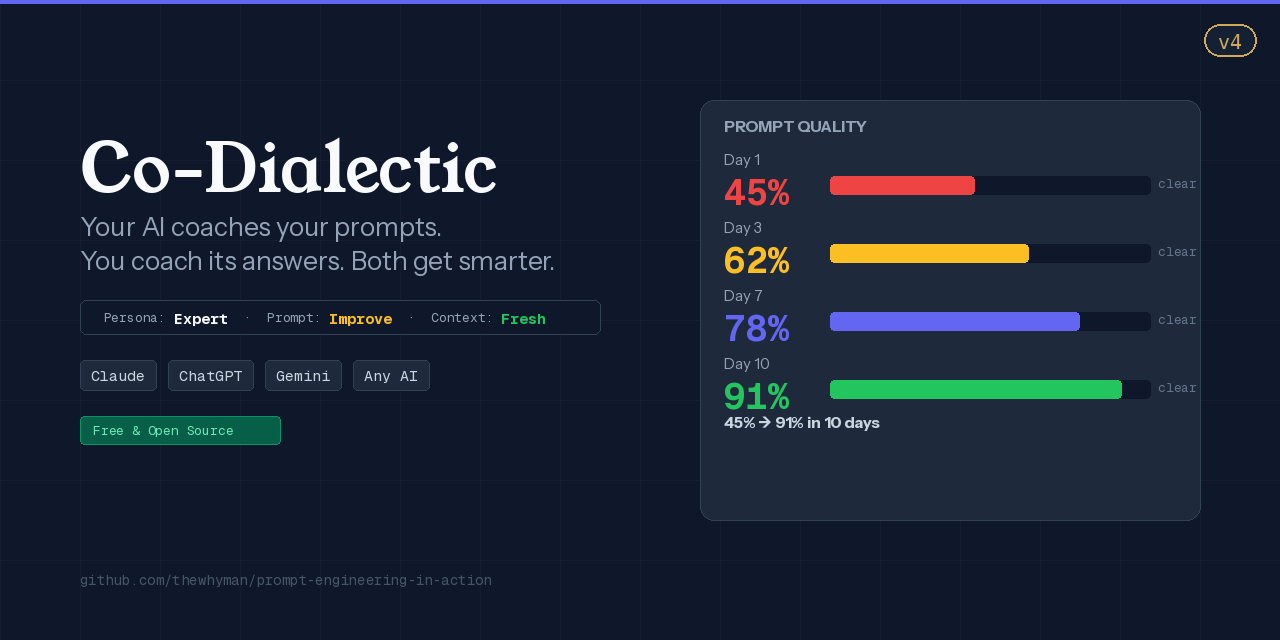
Co-Dialectic v4 — Your AI Is Only as Good as the Conversation
The most expensive bug is the one you specified wrong. Sharpening the prompt before it runs is cheaper than a fourth attempt.
Read the research →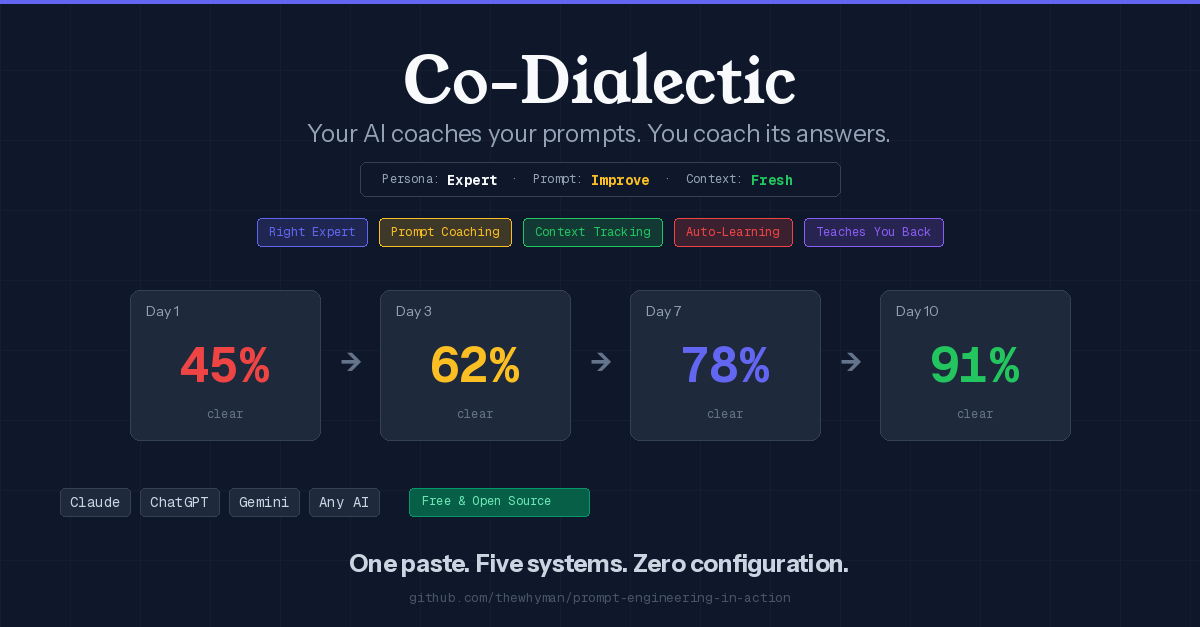
The Language Bridge
6,000 hours on two questions about AI. Precision in how you ask is the skill, not the tooling.
Read the research →
Why Your Site Is Invisible to ChatGPT (Even When Google Loves You)
Ranking on Google and being citable by an AI engine are different problems. Asked four engines the same question and compared.
Read the research →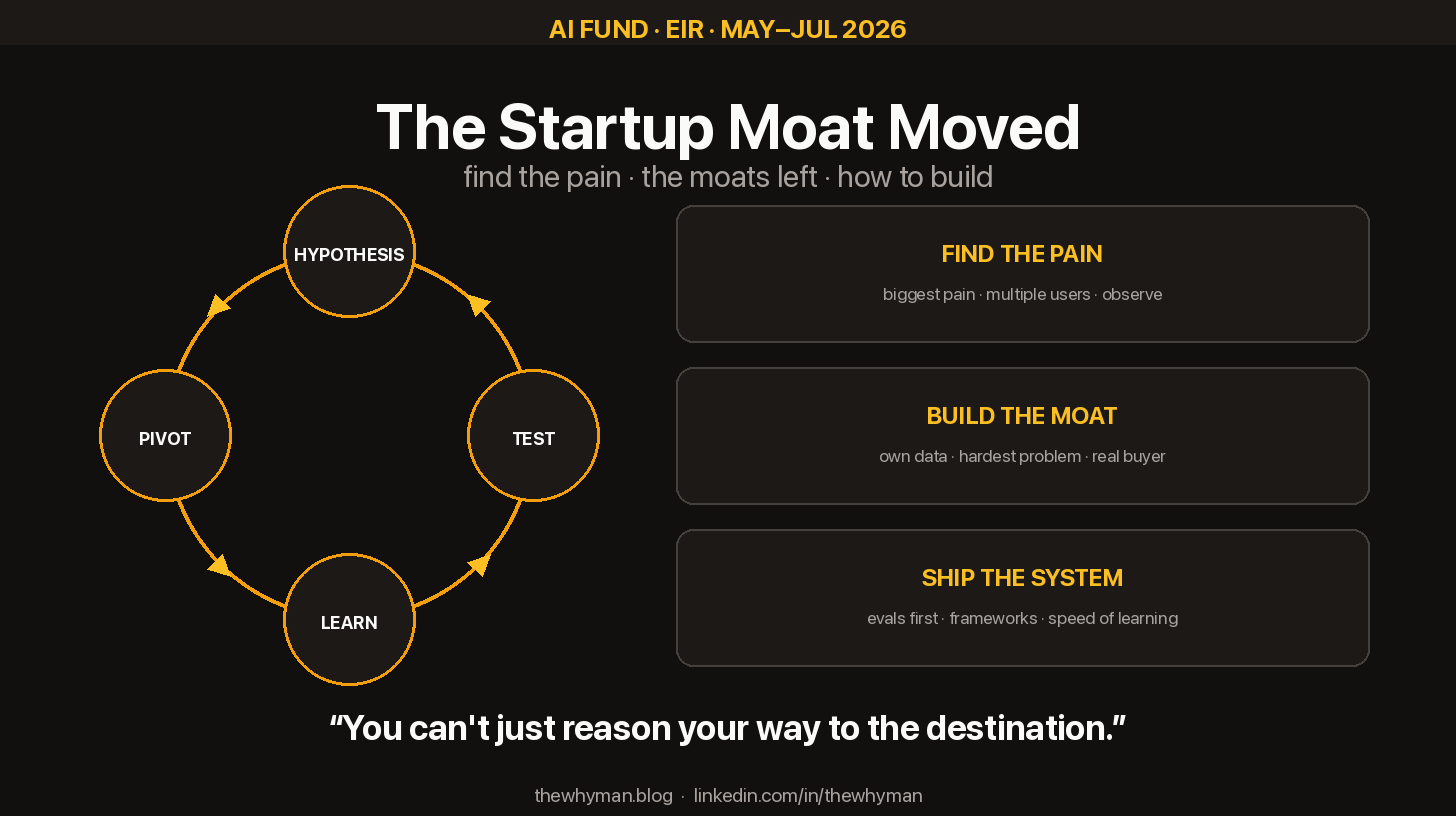
The Startup Moat Moved: What Every AI-Native Founder Has to Unlearn
19 of 22 confirmed the problem was real. Nobody had a budget, an owner, or a deadline. Problem recognition is not demand.
Read the research →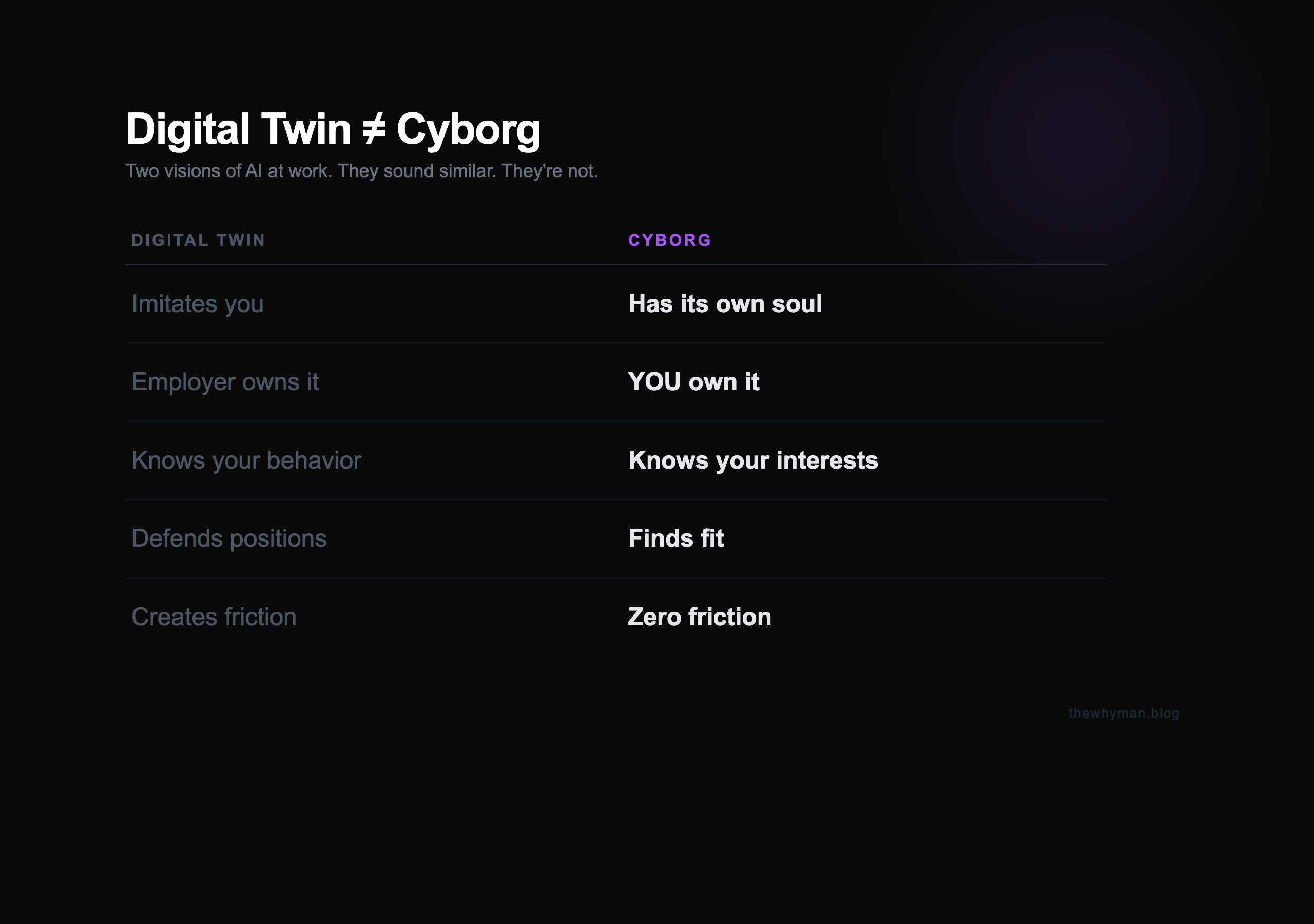
The Cyborg — Your Cyborg Goes to Work
The question is not whether your employer gives you an AI assistant. It is whose assistant it will be.
Read the research →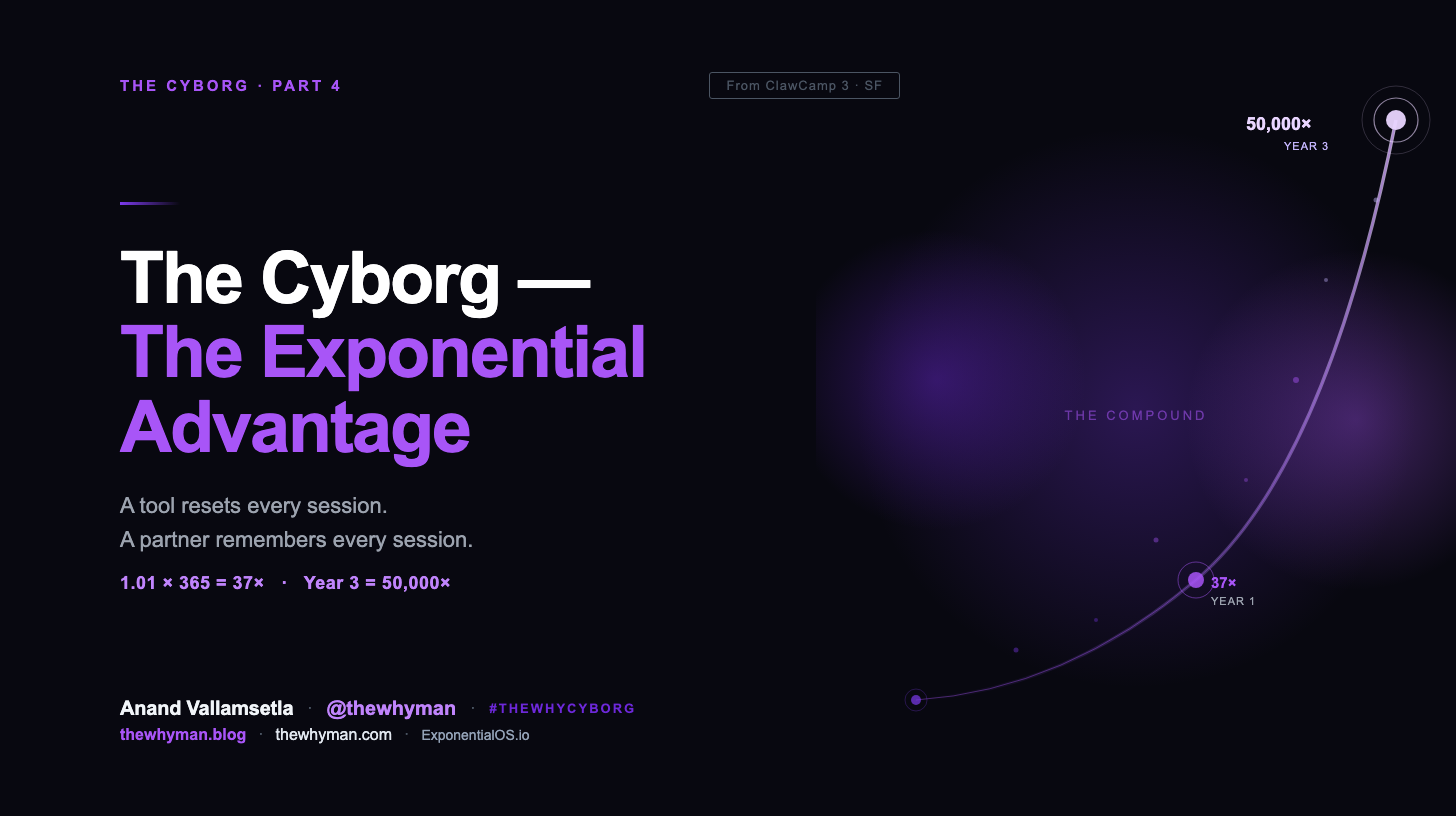
The Cyborg — The Exponential Advantage
The math and the architecture of what compounds when you stop starting over every session.
Read the research →All of it is free and public on thewhyman.blog.
Be first when xTeamOS launches.
Same founding cohort model as xHumanOS — early access, founding team pricing, direct line to product. Register interest now and we'll reach out when we're ready.
Using xOS today? Start with xHumanOS → live in beta.